Welcome to WordPress. This is your first post. Edit or delete it, then start writing!
Blog
-

Implications of AI Adoption on the Semiconductor Ecosystem Across Industry and Academia
- Hosted By: Manipal University
- Location: Jaipur, India (Virtual)
- Date: 8th/9th February 2026
-
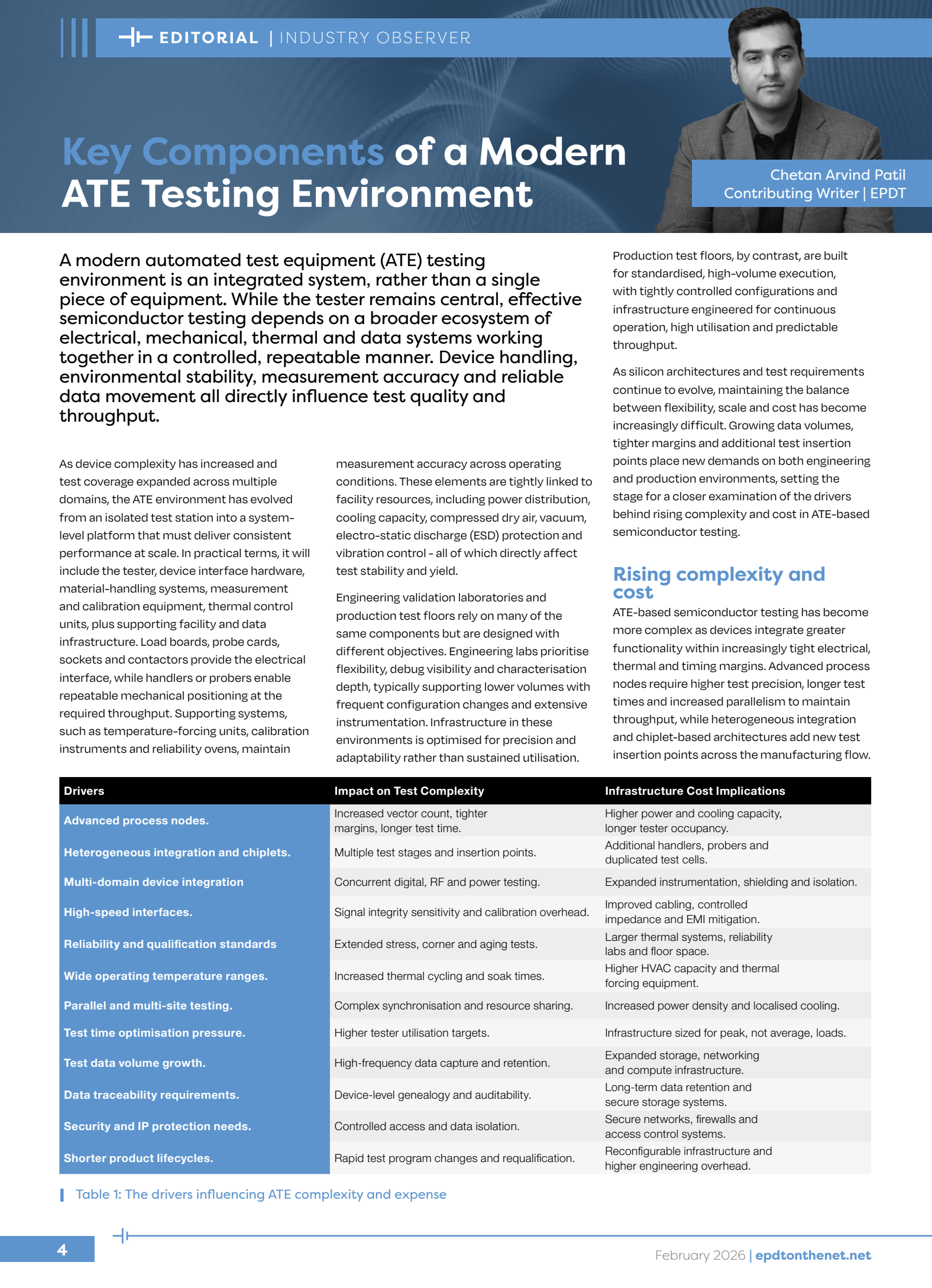
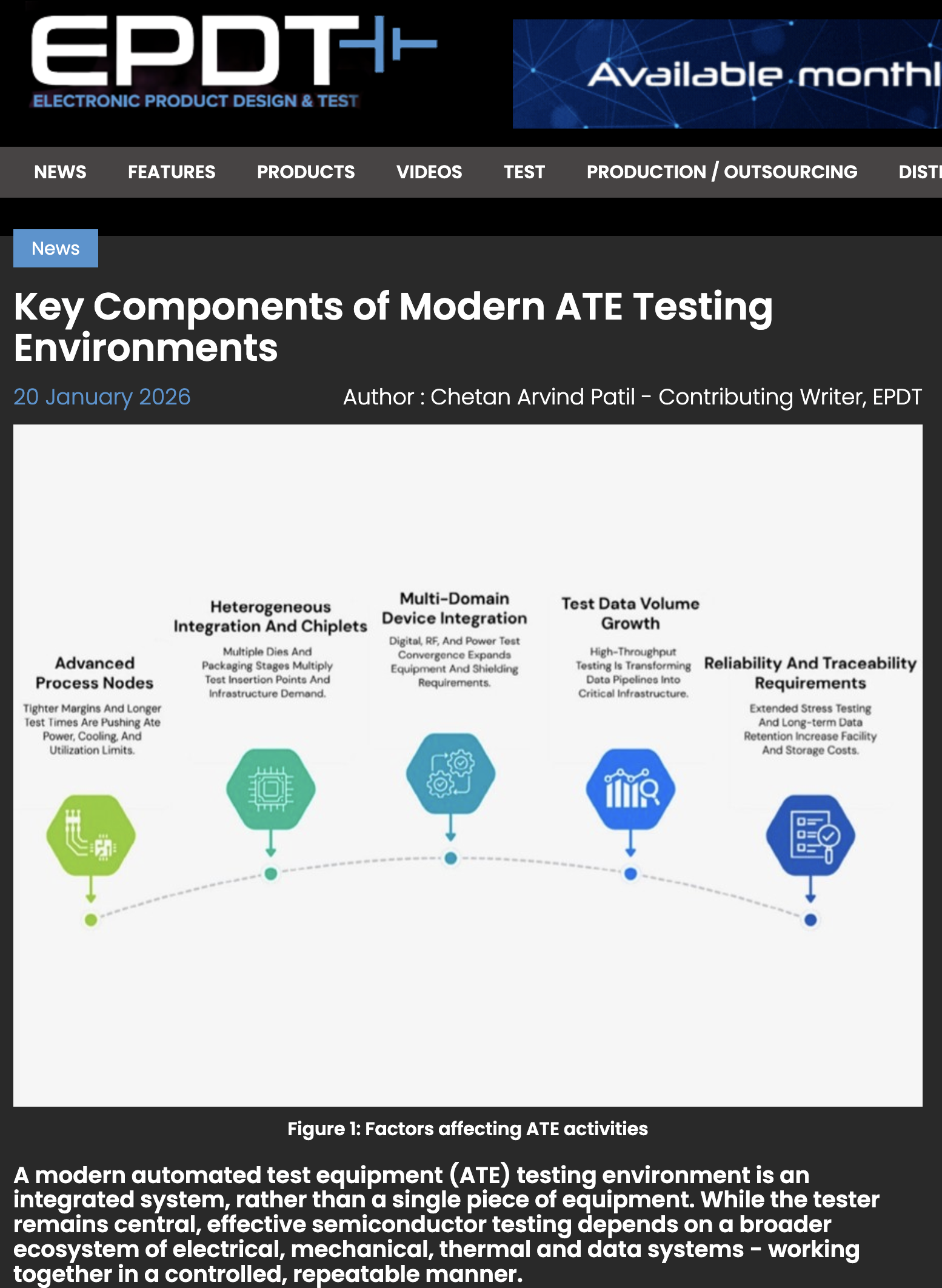
Key Components of Modern ATE Testing Environments
Published By: Electronics Product Design And Test
Date: February 2026
Media Type: Online Media Website And Digital Magazine -

The Strategic Crossroads Of AI SoC Development
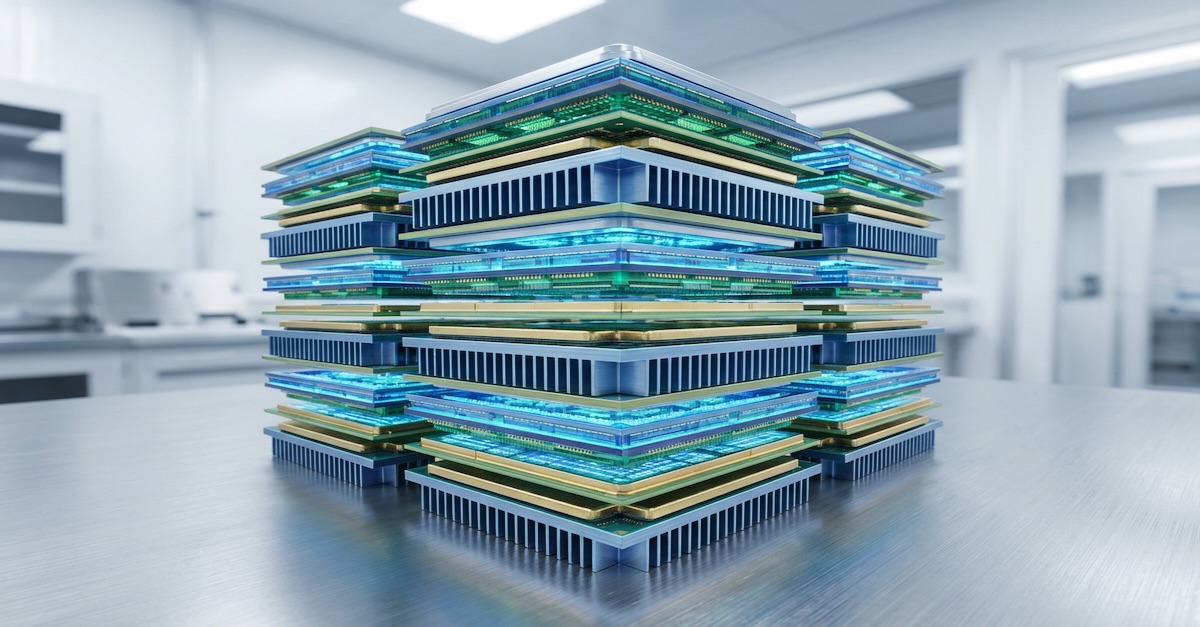
Image Generated Using Nano Banana
Strategic Context
AI SoC development is now a board-level strategic choice, not just a technical decision. The question is no longer if AI acceleration is needed, but who should own the silicon. As AI workloads grow and diversify, companies must decide whether to build custom silicon in-house or outsource it. This decision affects performance, organization, capital, and long-term competitive standing.
On top, this crossroads marks a more profound shift in how value is created in semiconductors. AI models, data pipelines, software stacks, and silicon architectures are tightly coupled. When this coupling is strong, silicon becomes strategic. Where workloads are fluid or experimental, flexibility matters more than ownership. Companies must understand where they fall on this spectrum before choosing a path.
To make the right choice, companies must first gain clarity on their own priorities, capabilities, and competitive context. Only then can they decide whether to pursue custom silicon or leverage vendor solutions for AI.
In-House Control
Developing AI SoCs in-house offers a level of architectural and system control that is difficult to replicate through outsourcing. Companies can tailor compute, memory hierarchy, interconnects, and power management directly to their dominant workloads.
Over time, this alignment compounds into meaningful advantages in performance per watt, latency predictability, and system efficiency, especially for large, recurring AI workloads.
In-house development also establishes a direct feedback loop between silicon performance and deployment data. Real-world data informs ongoing design refinement and model optimization, which is critical as AI usage continually evolves.
This level of control, however, comes at a high cost. In-house AI SoC initiatives require long-term investment, cross-disciplinary talent, and internal management of risks such as yield, packaging, software, and supply chains. For organizations lacking scale or extended product timelines, these demands may outweigh the advantages.
Outsourcing Tradeoffs
Outsourcing AI SoC development, whether through merchant silicon or semi-custom partnerships, prioritizes speed, flexibility, and risk reduction. It allows companies to deploy AI capabilities rapidly. Organizations can adapt to evolving model architectures. They can also leverage mature software ecosystems without bearing the full cost of silicon ownership. For many organizations, this is not a compromise but a rational optimization.
Merchant platforms also benefit from aggregated learning across multiple customers. Yield improvements, reliability insights, and software tooling mature faster when spread across a broad user base. This shared progress can be hard for a single in-house program to match and is particularly true in the early stages of AI adoption.
Dimension In-House AI SoC Outsourced AI SoC Architecture control Full, workload-specific Limited to vendor roadmap Time to deployment Multi-year cycles Rapid, months-scale Upfront investment Very high Lower, predictable Long-term cost curve Optimizable at scale Vendor-dependent Software–hardware co-design Deep, iterative Constrained, abstracted Supply-chain exposure Direct ownership Shared with vendor Differentiation potential High Moderate to low That said, outsourcing inevitably limits differentiation at the silicon layer. Roadmap, dependency, supply constraints, and pricing dynamics are externalized risks. As AI becomes central to product identity or cost structure, these dependencies can become strategic bottlenecks. Convenience can turn into constraint.
Hybrid Direction
In practice, the industry is converging towards hybrid strategies rather than absolute positions. Many companies train AI models on merchant platforms but deploy custom silicon for inference. Others start with outsourced solutions to validate workloads. They internalize silicon once scale and stability justify the investment. This phased approach reduces risk and preserves future optionality.
What matters most is intentionality. In-house development should be driven by clear workload economics and platform strategy, not prestige. Outsourcing should be a strategic choice, not a default from organizational inertia.
The hybrid path works best when companies know which layers of the stack truly differentiate them. They should also know which layers are better left to ecosystem partners.
At this strategic crossroads, AI SoC decisions are about ownership of learning, not just ownership of transistors. Companies that align silicon strategy with data, software, and long-term business intent will navigate this transition successfully.
-
The Semiconductor Foundations To Drive Data Center Networking
Image Generated Using Nano Banana
Data Center Networking Became A Silicon Problem
Data center networking has moved from a background enabler to a key driver of performance. In cloud and AI environments, network speed and reliability directly affect application latency, accelerator usage, storage throughput, and cost per workload.
As clusters expand, the network evolves from a minor role to a system-level bottleneck. At a small scale, inefficiencies go unnoticed. At a large scale, even slight latency spikes, bandwidth limits, or congestion can idle expensive compute, leaving GPUs or CPUs waiting on data transfers.
Modern networking advances are now propelled by semiconductor breakthroughs. Faster, more stable data movement relies less on legacy design and more on cutting-edge high-speed silicon: custom ASICs, NICs, SerDes, retimers, and the supporting power and timing architectures.
Meanwhile, networking progress is constrained by physical limits. Signal integrity, packaging density, power delivery, and thermal management set the upper bound for reliable bandwidth at scale. Today’s data center networks increasingly depend on semiconductors that can deliver high throughput and low latency within practical power and cooling limits.
Networks Are Being Redesigned For AI Scale
The shift from traditional enterprise traffic to cloud-native services and AI workloads has reshaped data center communication. Instead of mostly north-south flows between users and servers, modern environments see heavier east-west traffic where compute, storage, and services constantly exchange data. This increases pressure on switching capacity, congestion control, and latency consistency.
AI training further intensifies the challenge. Distributed workloads rely on frequent synchronization across many accelerators, so even small network delays can reduce GPU utilization. As clusters grow, networks must handle more simultaneous flows and higher-bandwidth collective operations while remaining reliable.
As a result, data center networks are no longer built just for connectivity. They are engineered for predictable performance under sustained load, behaving more like a controlled system component than a best effort transport layer.
Building Blocks That Define Modern Networking
Modern data center networking is increasingly limited by physics. As link speeds rise, performance depends less on traditional network design and more on semiconductor capabilities such as high speed signaling, power efficiency, and thermal stability.
Custom ASICs and advanced SerDes enable higher bandwidth per port while maintaining signal integrity. At scale, reliability and predictable behavior also become silicon-driven, requiring strong error correction, telemetry, and stable operation under congestion and load.
Data Center Networking Need Semiconductor Foundation Higher link bandwidth Advanced high-speed data transfer techniques, signaling, equalization, clocking design Low and predictable latency at scale Efficient switch ASIC pipelines, cut through forwarding, optimized buffering Scaling without power blowup Power efficient switch ASICs, better voltage regulation, thermal aware design Higher reliability under heavy traffic Error detection, improved silicon margins More ports and density per rack Advanced packaging, high layer substrates, thermal co-design A key transition ahead is deeper optical adoption. Electrical links work well over short distances, but higher bandwidth and longer reach push power and signal integrity limits, making optics and packaging integration a growing differentiator.
Means For The Future Of Data Center Infrastructure
Data center networking is certainly becoming a platform decision, not just a wiring decision.
As AI clusters grow, networks are judged by how well they keep accelerators busy. Networks are also judged by how consistently they deliver bandwidth and move data per watt. This shifts the focus away from peak link speed alone and toward sustained performance under real congestion and synchronization patterns.
For the computing industry, this means infrastructure roadmaps will be shaped by semiconductor constraints and breakthroughs. Power delivery, thermals, signal integrity, and packaging density will set the limits. These factors determine what network architectures can scale cleanly.
As a result, future data centers will place greater emphasis on tightly integrated stacks. These stacks will combine switch silicon, NICs or DPUs, optics, and system software into a coordinated design.
The key takeaway is simple. Next-generation networking will not be defined only by racks and cables. Semiconductor technologies will define bandwidth that is predictable, scalable, and energy-efficient at AI scale.
-
Key Components of Modern ATE Testing Environments
Published By: Electronics Product Design And Test
Date: January 2026
Media Type: Online Media Website And Digital Magazine -
The Key Pillars Of Compute Infrastructure Built On Semiconductor Solutions
Image Generated Using Nano Banana
Compute Infrastructure For New-Age Applications
Modern workloads are AI-heavy, data-intensive, latency-sensitive, and increasingly distributed. These characteristics are reshaping the compute infrastructure. Traditional enterprise applications relied mainly on CPU-centric execution with moderate memory and networking. In contrast, new-age workloads demand sustained high throughput. They also require rapid access to large datasets and efficient scaling across accelerators and clusters.
As a result, compute infrastructure is no longer just a server selection decision. It has become a system-level semiconductor challenge spanning architecture, memory hierarchy, packaging, and high-speed connectivity.
Modern platforms are therefore evolving into heterogeneous environments. These bring together CPUs, GPUs, NPUs, and workload-specific accelerators. Each is aligned to distinct performance and efficiency requirements. Future infrastructure must support a mix of training and inference, analytics and simulation, and cloud-scale orchestration. Success is increasingly defined by system balance.
The most capable platforms are not those with the fastest individual engines. They are those that best optimize the end-to-end flow of compute, memory access, and data movement.
Critical Pillars: Compute, Memory And Interconnect
Compute forms the foundation of infrastructure. In modern systems, it is no longer a single-CPU-only construct. Instead, it has expanded into a heterogeneous mix of compute engines. These include GPUs (graphics processing units) for parallel acceleration, NPUs (neural processing units) for power-efficient AI inference, DPUs (data processing units) for networking and infrastructure offload, and workload-specific ASICs (application-specific integrated circuits) built for sustained throughput at scale. This evolution enables platforms to better meet new workload demands, such as massive parallelism, mixed-precision execution, and domain-specific performance.
At the same time, heterogeneous computing also introduces new layers of complexity at the platform level. Scheduling across multiple engines becomes more challenging. Efficiently partitioning workloads and orchestrating dataflow across compute pools are key determinants of real-world performance.
Ultimately, infrastructure quality now relies on the system’s ability to balance execution, data access, and scalability, not just compute power.
Pillar What it Represents Modern System Components Primary Workload Pressure Typical Bottleneck Design Focus for New-Age Infrastructure Compute Execution engines that run workloads CPU, GPU, NPU, DPU, ASIC/XPU Parallelism, throughput, mixed precision, specialization Underutilization due to memory/interconnect limits Heterogeneous compute mapping + efficient workload orchestration Memory Data storage and delivery to compute engines Cache hierarchy, HBM, DDR/LPDDR, pooled memory Bandwidth + capacity demand, fast data access Data starvation, cache inefficiency, latency Bandwidth-rich hierarchy + locality-aware architecture Interconnect Data movement fabric across the system NoC, chiplet links, PCIe/CXL, cluster networking Distributed training/inference and scaling across accelerators Communication overhead, link saturation, scaling ceiling Low-latency scalable fabrics + topology-aware communication Memory is often the biggest limiter of real performance because modern workloads are fundamentally data-driven. AI, analytics, and streaming applications demand not only large capacity, but also high bandwidth and low-latency access to keep compute engines fully utilized. As a result, memory hierarchy, spanning caches, HBM near accelerators, and system memory, has become a strategic part of infrastructure design.
Interconnect defines how efficiently data moves across chips, packages, boards, and clusters, and it now acts as a primary scaling constraint for distributed AI and cloud workloads. Even with strong compute and memory, systems can underperform if the interconnect becomes saturated or adds latency, making scalable, low-overhead communication essential for modern infrastructure performance and efficiency.
Bottlenecks To Overcome
One of the biggest bottlenecks in next-generation compute infrastructure is the utilization gap. Compute engines can deliver extreme throughput, but they remain underused because memory subsystems cannot supply data fast enough. This is even more severe with AI and parallel workloads. Sustained performance depends on continuously feeding thousands of compute lanes with high-bandwidth, low-latency data access.
Platforms struggle to convert peak silicon capability into consistent real-world performance without stronger cache efficiency, improved data locality, and bandwidth-rich memory hierarchies.
A second bottleneck is the interconnect scaling ceiling. Performance stops scaling efficiently as more accelerators and nodes are added. This is especially true in multi-GPU and multi-node environments, where communication overhead dominates. At the same time, rising workload diversity is pushing infrastructure toward heterogeneous compute and specialization. This increases the need for smarter orchestration across the full stack.
Ultimately, compute infrastructure for new-age applications will be defined by its balance of compute, memory, and interconnect as a unified system. The future will reward platforms that deliver not only faster components, but sustained performance, efficiency, and scalability for evolving workloads.
-
The Semiconductor Shift Toward Heterogeneous AI Compute
Image Generated Using Nano Banana
The Changing Shape Of AI Workloads
AI workloads have rapidly evolved. They have shifted from lengthy, compute-intensive training runs to an ongoing cycle. This cycle includes training, deployment, inference, and refinement. AI systems today are expected to respond in real time, operate at scale, and run reliably across a wide range of environments. This shift has quietly but fundamentally changed what AI demands from computing hardware.
In practice, much of the growth in AI compute now comes from inference rather than training. Models are trained in centralized environments and then deployed broadly. They support recommendations, image analysis, speech translation, and generative applications. These inference workloads run continuously. They often operate under tight latency and cost constraints. They favor efficiency and predictability over peak performance. As a result, the workload profile is very different from the batch-oriented training jobs that initially shaped AI hardware.
At the same time, AI workloads are defined more by data movement than by raw computation. As models grow and inputs become more complex, moving data through memory hierarchies and across system boundaries becomes a dominant factor. It impacts both performance and power consumption. In many real deployments, data access efficiency matters more than computation speed.
AI workloads now run across cloud data centers, enterprise setups, and edge devices. Each setting limits power, latency, and cost in its own way. A model trained in one place may run in thousands of others. This diversity makes it hard for any one processor design to meet every need. It pushes the field toward heterogeneous AI compute.
Why No Single Processor Can Serve Modern AI Efficiently
Modern AI workloads place fundamentally different demands on computing hardware, making it difficult for any single processor architecture to operate efficiently across all scenarios. Training, inference, and edge deployment each emphasize different performance metrics, power envelopes, and memory behaviors. Optimizing a processor for one phase often introduces inefficiencies when it is applied to another.
AI Workload Type Primary Objective Dominant Constraints Typical Processor Strengths Where Inefficiency Appears Model Training Maximum throughput over long runs Power density, memory bandwidth, scalability Highly parallel accelerators optimized for dense math Poor utilization for small or irregular tasks Cloud Inference Low latency and predictable response Cost per inference, energy efficiency Specialized accelerators and optimized cores Overprovisioning when using training-class hardware Edge Inference Always-on efficiency Power, thermal limits, real-time response NPUs and domain-specific processors Limited flexibility and peak performance Multi-Modal Pipelines Balanced compute and data movement Memory access patterns, interconnect bandwidth Coordinated CPU, accelerator, and memory systems Bottlenecks when using single-architecture designs As AI systems scale, these mismatches become visible in utilization, cost, and energy efficiency. Hardware designed for peak throughput may run well below optimal efficiency for latency-sensitive inference, while highly efficient processors often lack the flexibility or performance needed for large-scale training. This divergence is one of the primary forces pushing semiconductor design toward heterogeneous compute.
What Makes Up Heterogeneous AI Compute
Heterogeneous AI compute uses multiple processor types within a single system, each optimized for specific AI workloads. General-purpose processors manage control, scheduling, and system tasks. Parallel accelerators handle dense operations, such as matrix multiplication.
Domain-specific processors target inference, signal processing, and fixed-function operations. Workloads are split and assigned to these compute domains. The decision is based on performance efficiency, power constraints, and execution determinism, not on architectural uniformity.
This compute heterogeneity is closely tied to heterogeneous memory, interconnect, and integration technologies. AI systems use multiple memory types to meet different bandwidth, latency, and capacity needs. Often, performance is limited by data movement rather than arithmetic throughput.
High-speed on-die and die-to-die interconnects help coordinate compute and memory domains. Advanced packaging and chiplet-based integration combine these elements without monolithic scaling. Together, these components form the foundation of heterogeneous AI compute systems.
Designing AI Systems Around Heterogeneous Compute
Designing AI systems around heterogeneous compute shifts the focus from individual processors to coordinated system architecture. Performance and efficiency now rely on how workloads are split and executed across multiple compute domains, making system-wide coordination essential. As a result, data locality, scheduling, and execution mapping have become primary design considerations.
Building on these considerations, memory topology and interconnect features further shape system behavior. These often set overall performance limits, more so than raw compute capability.
Consequently, this approach brings new requirements in software, validation, and system integration. Runtimes and orchestration layers must manage execution across different hardware. Power, thermal, and test factors must be addressed at the system level.
Looking ahead, as AI workloads diversify, heterogeneous system design enables specialization without monolithic scaling. Coordinated semiconductor architectures will form the foundation of future AI platforms.
-
The Semiconductor Shift When Latency And Throughput Architectures Join Forces
Image Generated Using Nano Banana
Two Worlds Of AI Compute Are Finally Colliding
For more than a decade, AI silicon has evolved along two independent trajectories. On one side sat throughput-optimized architectures built to train massive models across thousands of accelerators. These prioritize raw FLOPS, memory bandwidth, and scaling efficiency. On the other hand, latency-optimized designs were engineered to deliver fast, deterministic inference. They are used at the edge or in tightly constrained data center environments. Each solved a different bottleneck, served a different buyer, and spoke a different architectural language.
That division made sense when training and inference occurred separately. Training was infrequent and centralized in hyperscale data centers. Inference ran continuously, near users, under strict latency and power limits. Chip companies specialized: some in large-scale matrix math, others in microsecond responsiveness, real-time scheduling, and efficient small-batch execution.
The AI boom of the last few years has collapsed that neat divide. Large language models, multimodal systems, and agentic AI now blur the boundary between training and inference. Models are fine-tuned continuously and updated frequently. They are increasingly deployed in interactive settings. Here, response time directly shapes user experience. In this environment, solving only for throughput or only for latency is no longer sufficient.
As a result, a structural shift is underway in the semiconductor industry. Chip companies that historically dominated one side of the equation are responding. They are acquiring, partnering, or redesigning their architectures to address the other side. When latency-first and throughput-first philosophies converge under a single entity, the impact extends far beyond product roadmaps. This shift reshapes how AI computing is designed, deployed, and monetized across the entire ecosystem.
Latency Versus Throughput And Economic Tradeoffs
Latency-optimized and throughput-optimized chips differ in almost every major design choice, reflecting different workload, integration, and cost assumptions.
Latency-focused architectures emphasize minimizing response time for individual requests by optimizing for small batch sizes, predictable execution paths, and efficient handling of workloads with extensive control logic. These chips commonly serve inference for recommendation systems, conversational AI, and autonomous systems.
In contrast, throughput-focused architectures maximize processing of large, regular workloads through aggressive parallelism, making them suited for the prolonged training of massive neural networks.
The table below summarizes key architectural distinctions:
Dimension Latency-Optimized Architectures Throughput-Optimized Architectures Primary Goal Minimize response time Maximize total compute per unit time Typical Workload Inference, real-time AI Training, large-scale batch jobs Batch Size Small to single-request Large, highly parallel batches Memory Behavior Low latency access, caching High bandwidth, streaming Interconnect Limited or localized High-speed, scale-out fabrics Power Profile Efficiency at low utilization Efficiency at high utilization Software Stack Tight HW-SW co-design Framework-driven optimization As a result, this convergence exposes inefficiencies when architectures stay siloed. Throughput-optimized chips can struggle to deliver consistent, low-latency inference unless you overprovision. Latency-optimized chips often lack the scaling efficiency needed for large-scale model training. The economic consequence is fragmented infrastructure and a rising total cost of ownership.
What Happens When One Company Owns Both Sides Of The Equation
When a single chip company unites the industry’s best latency and throughput solutions, the impact transcends simple product expansion. This move redefines design philosophy, software stacks, and customer value propositions.
From an architecture standpoint, convergence enables more balanced designs. Unified companies can deliberately trade off between peak throughput and tail latency, rather than blindly optimizing for a single metric. We are already seeing accelerators that support flexible batching, adaptive precision, and mixed workloads, allowing the same silicon platform to serve training, fine-tuning, and inference with fewer compromises.
Software is where the impact becomes most visible. Historically, separate hardware platforms required separate toolchains, compilers, and optimization strategies. Under one entity, these layers can be harmonized. A single software stack that understands both training and inference enables smoother model transitions from development to deployment, reducing friction for customers and shortening time-to-value.
The table below highlights how unified ownership changes system-level outcomes:
Aspect Fragmented Latency / Throughput Vendors Unified Architecture Vendor Hardware Portfolio Specialized, siloed products Co-designed, complementary products Software Stack Multiple toolchains Unified compiler and runtime Customer Workflow Disjoint training and inference Seamless model lifecycle Infrastructure Utilization Overprovisioned, inefficient Higher utilization, shared resources Innovation Pace Incremental within silos Cross-domain optimization Strategic Control Dependent on partners End-to-end platform leverage Strategically, this convergence decisively strengthens negotiating power with both hyperscalers and enterprise customers. Vendors delivering a coherent training-to-inference platform command stronger positions in long-term contracts and ecosystem partnerships.
Consequently, there is also a competitive implication. Unified vendors can shape standards and influence frameworks. They can guide developer behavior in ways fragmented players cannot. As AI computing shifts from a commodity to a strategic asset, control over both latency and throughput becomes industrial power.
New Center Of Gravity In AI Compute
The convergence of latency and throughput architectures marks a turning point for the AI semiconductor industry. A technical distinction is now a strategic divide. Some companies offer isolated solutions. Others provide integrated platforms.
As training and inference workloads merge, chip companies treating AI compute as a continuous lifecycle will win. This approach avoids viewing each step as a separate phase. Combining latency and throughput optimized solutions brings architectural balance. It enables software coherence and economic efficiency.
This shift marks a new center of gravity for the AI ecosystem, as compute is no longer just about speed or scale. Now, it is about adaptability and utilization.
It also supports changing AI needs without frequent infrastructure redesign.
-
The Rising Cost Of Semiconductor Test Analytics
Image Generated Using Nano Banana
What Is Silicon Test Analytics
Silicon test analytics refers to the systematic analysis of data generated during semiconductor testing to improve yield, product quality, and manufacturing efficiency. It operates across wafer sort, final test, and system-level test, using test results to understand how silicon behaves under electrical, thermal, and functional stress.
At a practical level, test analytics converts raw tester outputs into engineering insight. This includes identifying yield loss mechanisms, detecting parametric shifts, correlating failures across test steps, and validating the effectiveness of test coverage. The objective is not only to detect failing devices, but to understand why they fail and how test outcomes evolve across lots, wafers, and time.
Unlike design-time analysis, silicon test analytics is closely tied to manufacturing reality. Data is generated continuously under production constraints and must reflect real test conditions, including tester configurations, temperature settings, test limits, and handling environments. As a result, analytics must account for both device behavior and test system behavior.
In advanced production flows, silicon test analytics also supports decision-making beyond yield learning. It informs guardbanding strategies, retest policies, bin optimization, and production holds or releases.
These decisions directly affect cost, throughput, and customer quality, and as test analytics becomes embedded in daily manufacturing decisions, it becomes increasingly important to understand the rising cost associated with test data analytics.
What Has Changed In Silicon Test Data Analysis
The defining change in silicon test data is its overwhelming scale. Modern devices generate much more test information due to higher coverage, deeper analysis, and complex requirements. What used to be manageable files are now relentless, high-volume streams.
The increase in test data generation results in higher costs due to longer test times, more measurements, more diagnostic captures, and more retest loops. Even precautionary or future-use data incurs immediate expenses, including tester time, data transfer, and downstream handling.
Storage demands have grown as test data volumes now reach gigabytes per wafer and terabytes per day in production. Storing such volumes requires scalable, governed systems and incurs costs regardless of how much data is actually analyzed, since unused data still consumes resources.
Analysis has also become more resource-intensive. Larger, more complex datasets mean analysis has moved beyond manual scripts and local tools. Centralized compute environments are now required. Statistical correlation across lots, time, and test stages needs more processing power and longer runtimes, driving up compute costs and placing greater financial pressure on infrastructure budgets.
Maintaining these integrations adds to system complexity, increases licensing costs, and requires ongoing engineering effort, often resulting in higher overall operational expenses.
These developments have transformed test analytics from a lightweight task into a significant infrastructure challenge. Data generation, storage, analysis, and integration now drive operational costs and business decisions.

Image Credit: McKinsey & Company
Analytics Now Requires Infrastructure And Not Just Tools
As silicon test data volumes and complexity increase, analytics cannot be supported by standalone tools or engineer-managed scripts. What was once handled through local data pulls and offline analysis now requires always-available systems capable of ingesting, storing, and processing data continuously from multiple testers, products, and sites. Analytics has moved closer to the production floor and must operate with the same reliability expectations as test operations.
This shift changes the cost structure. Tools alone do not solve problems related to scale, latency, or availability. Supporting analytics at production scale requires shared storage, scalable compute, reliable data pipelines, and controlled access mechanisms. In practice, analytics becomes dependent on the underlying infrastructure that must be designed, deployed, monitored, and maintained, often across both test engineering and IT organizations.
Infrastructure Component Why It Is Required Cost Implication Data ingestion pipelines Continuous intake of high-volume tester output Engineering effort, integration maintenance Centralized storage Retention of raw and processed test data at scale Capacity growth, redundancy, governance Compute resources Correlation, statistical analysis, and model execution Ongoing compute provisioning Analytics platforms Querying, visualization, and automation Licensing and support costs MES and data integration Linking test data with product and process context System complexity and upkeep As analytics becomes embedded in manufacturing workflows, infrastructure is no longer optional overhead, it becomes a prerequisite. The cost of test analytics, therefore, extends well beyond software tools, encompassing the full stack needed to ensure data is available, trustworthy, and actionable at scale.
Cost Also Grows With Context And Integration
As test analytics becomes more central to manufacturing decisions, cost growth reflects not just data volume but also the effort to contextualize and integrate data into engineering and production systems. Raw test outputs must be tied to product genealogy, test program versions, equipment configurations, handling conditions, and upstream manufacturing data to deliver meaningful insight.
Without this context, analytics results can be misleading, and engineering decisions can suffer, forcing additional rounds of investigation or corrective action.
Building and maintaining this context is neither simple nor cheap. It needs data models that show relationships across disparate systems and interfaces between test data and MES, ERP, or PQM systems. Continuous engineering effort is needed to keep metadata accurate as products and processes evolve. Any change to test programs, equipment calibration, or product variants requires updating these integrations to keep analytics accurate and usable.
This trend matches broader observations in semiconductor analytics. While data volumes keep growing, many companies use only a small fraction of what they collect for decision-making. Industry analysis shows enterprises worldwide generate vast amounts of data but use only a small percentage for actionable insights. This highlights the gap between collection and effective use.
Ultimately, the rising cost of test analytics is structural. It reflects a shift from isolated file-based analysis to enterprise-scale systems. These systems must ingest, connect, curate, and interpret test data in context. As analytics matures from a manual exercise to an embedded capability, integration and data governance become major engineering challenges. This drives both investment and ongoing operational cost.
Eventually, understanding the economics of test analytics today requires looking beyond tools and data volumes. It means focusing on the systems and integrations that make analytics reliable, accurate, and actionable.